My First Territory in the Digital World
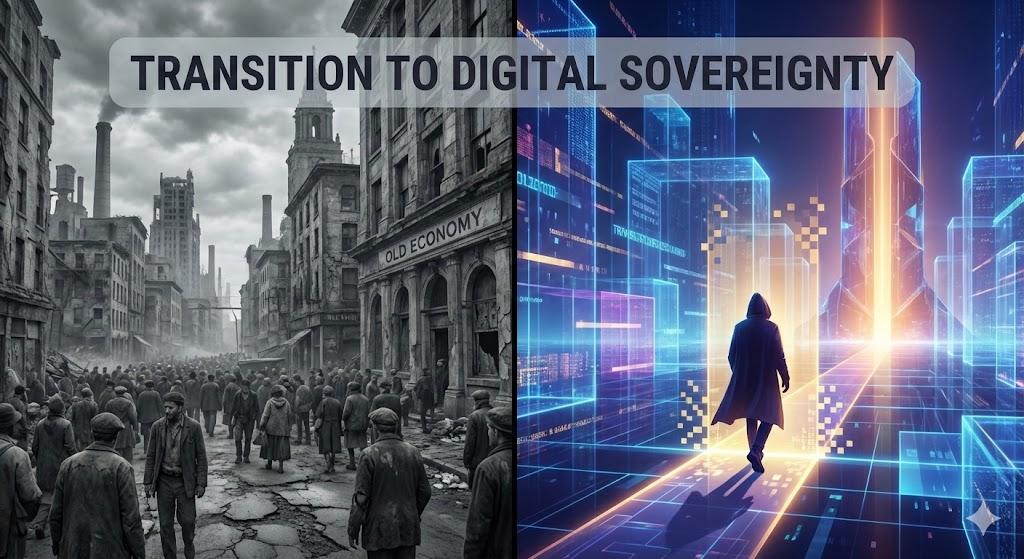
Why I Chose Plan B
In July 2024, I wrote down a judgment in my notes:
China is in a deleveraging cycle—from government to enterprises to individuals, everyone needs to reduce debt. Simply put, everyone needs to tighten their belts and pay back what they owe.
A year and a half has passed. Now it's January 2026, and this judgment hasn't become outdated—it's only become clearer.
The Deleveraging Dilemma
Households are already tightening—deflation, consumption downgrade, early mortgage repayments. On the enterprise side, some clearing has happened with real estate companies collapsing, but many zombie enterprises are still on life support. Meanwhile, government leverage is actually rising because someone has to provide the safety net.
This is the dilemma: if you let the market clear naturally, social instability risks are too high; if you keep propping things up, government leverage keeps climbing, just kicking the can down the road.
Essentially, the government is adding leverage to offset household and enterprise deleveraging. But this isn't real clearing—it's just delay.
Delay isn't a solution.
Two Paths
The government has two paths available.
Path One: Bet on technological breakthroughs. Hope that AI, new energy, aerospace, and other "new quality productive forces" can create a new wave of prosperity. If these industries generate enough growth, you can "outgrow" the debt problem—make the denominator bigger, and leverage ratios naturally fall.
Path Two: Enter suppression mode. Stop pursuing growth, just pursue stability. The government provides a basic safety net for everyone, market vitality drops to rock bottom, but society doesn't fall apart. Trade "low growth + low expectations + low consumption" for "low risk." Japan's "lost three decades" is somewhat this model.
These two paths aren't mutually exclusive. The government might be preparing both: externally promoting "new quality productive forces" to maintain confidence; internally quietly building a "safety net," preparing Plan B.
My Judgment
I choose to believe Plan B will happen.
Not because I'm pessimistic, but because of my judgment on AI: The AI trend is irreversible, but AI is not humanity's savior.
All work related to the digital world can be easily replaced by AI. This isn't alarmism—it's happening right now. For the physical world, massive unemployment waves are almost inevitable.
Can humanity build a new model? Like universal basic income? Theoretically yes, but given human nature and social inertia, this path is full of challenges. Waiting for the system to save you—you might not live to see that day.
Finding Your Place in the Digital World
But the digital world is different.
Resources in the physical world are limited—the pie is only so big, and when AI arrives, humanity's share shrinks. But the digital world's growth potential is unlimited. The question is: how do humans compete with AI in this world and find their place? It's a long road.
My choice is: Believe in myself, rely on my own strength to find my place in the digital world.
I want to build a capability—the ability to support myself no matter how the outside world changes.
My First Territory
Blockchain is my first territory in the digital world.
This metaphor isn't casual. For me, blockchain represents sovereignty in the digital world:
- Stake pool is my land, continuously producing
- Delegators are my supporters, our interests aligned
- Governance participation is my political rights
- Native assets are my currency issuance rights
Put together, this is a micro-economy. It can continuously generate cash flow, and it won't disappear because of some platform's policy changes.
Why Cardano
Many people ask me why I chose Cardano over other chains.
The answer is simple: its design lets ordinary people become part of the network. Running a Cardano stake pool doesn't require expensive hardware, doesn't require massive stake, doesn't require competing in an arms race with big capital. An ordinary server can make you a network node securing billions of dollars in assets.
More importantly, its staking mechanism: when users delegate ADA to your pool, the assets never leave the user's wallet, and there's no lock-up period. Users face zero financial risk, making the psychological barrier to supporting you extremely low. This is a "win-win crowdfunding"—you haven't taken users' money, yet by aggregating their stake, you've gained economic power.
This is what I call the "business chassis": an indie developer can use it to create continuous cash flow, while it comes with built-in membership systems and global payment capabilities.
For a sourced explanation of delegation, reward uncertainty, and how to verify PAO, read the Cardano staking and Pao Pool guide.
The support model built on this relationship is explored in Software Subscriptions Are Failing.
Conclusion
The future of work is no longer about finding a job, but about building your own survival system.
In this system, AI is your tool, massively amplifying your creativity; blockchain is your chassis, transforming your capabilities into stable asset returns through decentralized network incentives.
This is the complete form of the "sovereign individual": evolving from a worker dependent on systems to an independent individual who owns digital territory.
I don't know how far this path can go. But I know that rather than waiting for a savior who may never come, it's better to start building your first territory now.