Freedom of Creation: A New Paradigm for the AI Era
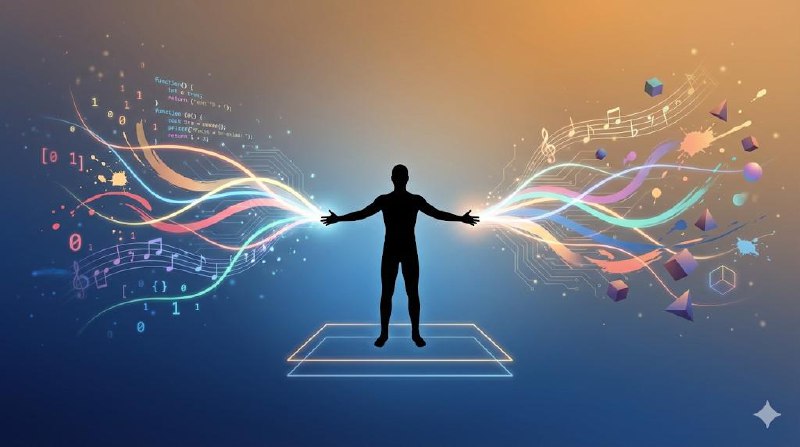
In early 2026, I had a vague but persistent feeling: large language models have become the universal compiler of our world.
I. The Universal Compiler
What is a compiler? It translates one language into another. C code compiles into machine code, TypeScript compiles into JavaScript.
Large models do essentially the same thing: they compile human intent into various forms of output—code, articles, music, images, videos.
Before, if you wanted to turn what's in your head into reality, you needed to learn different "languages":
- Want to write programs? Learn programming languages
- Want to compose music? Learn music theory and DAW software
- Want to create art? Learn bindng and rendering
Each form of expression has its own syntax, toolchain, and learning curve. Most people's ideas died at these thresholds.
Now, you only need one input: natural language. The compiler translates it into any form.
What does this mean?
The bottleneck has shifted upward.
The old bottleneck was execution ability—you had ideas, but couldn't code, couldn't compose, couldn't draw, so ideas stayed stuck in your head.
Now that the compiler handles the execution layer, the bottleneck moves up to the input layer:
- Imagination — What can you think of? How deep and unique is your understanding of the world?
- Language expression — Can you clearly describe what's in your head?
These two abilities used to be "nice to have." Now they're "core competencies."
II. The Value of Irrationality
But imagination and expression alone aren't enough.
If everyone uses the same compiler with similar prompts, outputs will converge. AI-generated content will become increasingly alike—correct, fluent, but soulless.
Where does differentiation come from?
From those irrational things: aesthetics, emotion, intuition, obsession.
Steve Jobs' obsession with rounded corners was irrational. Miyazaki's insistence on hand-drawing was irrational. Choosing Cardano over more "mainstream" chains is, in some sense, irrational.
But it's precisely these irrational elements that give work its soul and creators their distinctiveness.
Rationality makes things "usable." Irrationality makes things "desirable."
Code has become cheap, but taste hasn't. AI can build any product, but why do some make you want to use them while others make you want to close them? The difference lies in those ineffable "feelings."
So rational creation needs more irrational elements to become something unique.
III. Vibe Coding
This brings us to a new term: Vibe Coding.
Many think vibe coding is just "chatting with AI to write code." But vibe runs much deeper.
The core of vibe is atmosphere, feeling, intuition—a state driven not entirely by logical deduction, but by "feeling right."
Traditional coding: Requirements → Design → Implementation → Testing → Delivery. Every step must be rigorous, traceable, explainable.
Vibe coding: I have a vague feeling → Let's try it → Doesn't feel right, adjust → Until it "clicks."
It's more like improvisation than playing from sheet music. You're not executing a preset plan; you're "conversing" with code/AI, discovering what you really want in the process.
Several layers of meaning here:
Tolerating ambiguity — Traditional engineering thinking requires clear definitions upfront. Vibe coding accepts "I don't know what I want yet"—start doing, clarify along the way.
Aesthetics-driven — Not "works is good enough," but "if it doesn't feel right, it's not right." That "not right" might be hard to articulate, but you just know.
Human-machine co-creation — AI isn't a tool; it's more like another musician in a jam session. You throw out a riff, it responds, you build on that, and what emerges surprises everyone.
Rapid iteration by intuition — Not waterfall-style "think it through before starting," but "ship something and see how it feels."
Vibe coding actually has a high barrier—it requires taste. People without taste don't vibe good things; they just vibe garbage.
IV. The Confidence to Create
But ultimately, vibe is just form. Confidence is the essence.
Before, when you wanted to do something, your first thoughts were: Can I do this? How long to learn? What's the cost? What if I fail?
These questions were like a wall, blocking most ideas at the "just thinking about it" stage.
Now large models have torn down that wall. You have an idea, and hours later you can see a prototype. Doesn't work? Throw it away, try the next one. The cost of trial and error approaches zero.
The changes this confidence brings are profound:
From "what can I do" to "what do I want to do" — Before, ability determined direction. Now, desire determines direction.
From "careful planning" to "bold experimentation" — Before, you had to think projects through before starting. Now you can do first, think later.
From "professional barriers" to "cross-disciplinary freedom" — Before, crossing fields meant starting from zero. Now crossing fields just requires having ideas.
What large models really give us isn't "more efficient tools"—it's freedom of creation.
V. The New Paradigm
Stringing these together, I see a new paradigm for creation:
- Large models are universal compilers — The execution layer is leveled; everyone can turn ideas into reality
- Imagination and expression become core — The bottleneck shifts from "how to do" to "what to do"
- Irrational elements create differentiation — Taste, aesthetics, obsession give work its soul
- Vibe is the posture of creation — Improvisation, dialogue, discovery in process
- Confidence is the fundamental change — Cost of failure approaches zero; creation becomes truly free
Under this paradigm, the strongest creators might be people like this:
With the structured thinking of science, able to break down complex problems clearly; With the imagination and expression of humanities, able to describe unique visions; With the taste and obsession of artists, knowing what "right" feels like; With the action bias of entrepreneurs, doing when thinking, iterating when done.
No experience in life is meaningless. Every moment of our past is cause and effect, ultimately constructing our unique perspective for observing the world.
This uniqueness is the most precious treasure of the AI era.