History Repeats: From the 1929 Great Depression to the AI Era's Debt Crisis
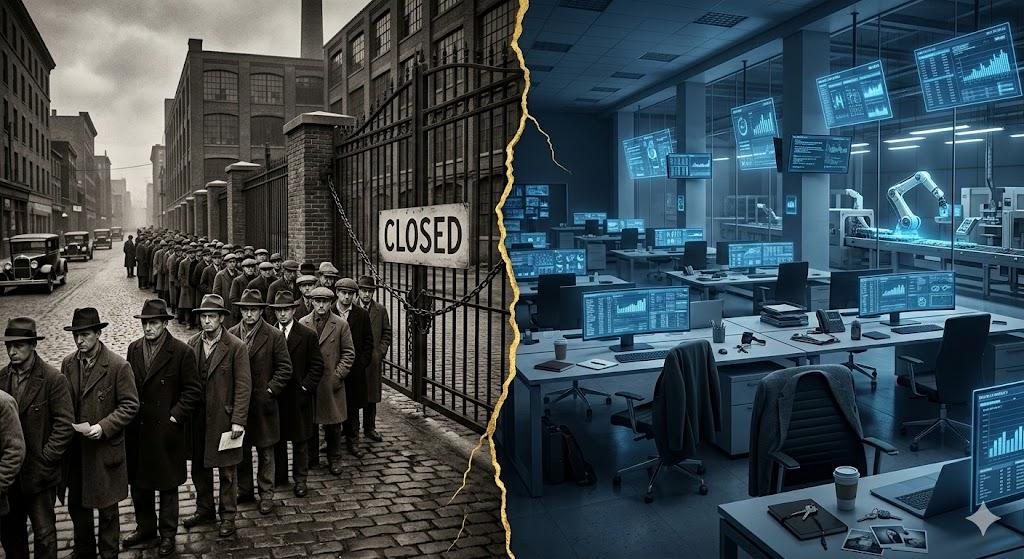
I. 1928-1929: The Death Knell Amid Euphoria
Before "Black Thursday" on October 24, 1929, America was in the midst of its most deceptive prosperity.
The Shadow of Coolidge Prosperity: In 1928, automobiles, radio, and construction peaked. Yet behind the boom, wealth distribution was grotesquely skewed: the richest 0.1% of Americans held as much wealth as the bottom 42% of families combined. Most people had to rely on "installment plans" to buy industrial goods they couldn't actually afford.
Wall Street on Leverage: The deadliest instrument was "margin trading." Investors needed only 10% down; brokers loaned the remaining 90%. This extreme leverage caused the 1929 stock market to completely decouple from the real economy, with the Dow multiplying several times over in just a few years.
Agriculture's Early Recession: Often overlooked by historians, rural America had already fallen into depression by 1928. Post-WWI agricultural surpluses caused farm incomes to plummet and rural banks to fail en masse — eerily similar to today's early signs of decline in certain manufacturing sectors and lower-tier markets.
II. 2026: The "Trinity" of AI, Debt, and Regulation
Compared to history, we stand at a more complex crossroads. If 1929 was about "overproduction," 2026 is the convergence of "technological displacement" and "debt illusion."
1. AI-Driven Structural Unemployment
Before 1929, America underwent a technological revolution with assembly line production. Ford-era industrialization boosted productivity by roughly 64%, while workers' real wages grew only about 12%. Factories ran at full capacity producing cars, radios, and washing machines, but ordinary workers couldn't afford to buy them. This "supply exceeding demand" reached a tipping point in 1929.
In 2026, as multimodal large models and embodied AI mature, administrative staff, translators, junior programmers, and legal assistants face mass layoffs. AI dramatically boosts corporate profits while severing the traditional channel through which wealth flows to workers. This "technological surplus" could easily replicate 1929's tragedy: AI produces infinite digital products, but the unemployed middle class can't afford to consume them.
Programmers are directing AI to replicate 1929's absurd paradox — the coal miner's child freezes because there's no coal for heating, because his father mined too much coal, causing oversupply, price collapse, and ultimately his father's unemployment.
2. The Alchemy of "Infinite Money Printing"
In 1929, the Federal Reserve chose to defend the gold standard and tighten monetary policy, ultimately triggering a deflationary spiral.
Today's governments follow the opposite logic — rather than let banks fail, let the currency devalue. What awaits us may not be deflation, but massive stagflation.
Banks may no longer fail en masse, but purchasing power will melt like snow. The survival pressure shifts from "having no money" to "money that doesn't last."
3. The Regulatory Net: From Gold to Digital Assets
In 1933, Roosevelt signed Executive Order 6102, forcibly purchasing civilian gold at $20.67 per ounce, then immediately raising it to $35 — essentially a disguised 40% confiscation of public wealth.
Today, outright confiscation of physical gold is unlikely, but as capital outflow pressures mount, controls on gold and foreign exchange are near-certain.
In the digital age, regulation may come through Central Bank Digital Currencies (CBDCs) or intensive tracking of physical asset transactions. When wealth tries to flee to gold, forex, or BTC, institutional barriers will be unprecedented. Asset "concealability" and "cross-border capability" will become the core battleground of wealth preservation.
III. Asset Map: Re-Anchoring Amid Turbulence
Equities (first victims): The Dow fell from 381 to 41, taking 25 years to recover. Select resource stocks like Homestake Mining surged against the tide — "scarce productivity" is the true safe haven.
Gold (the final arbiter): In the 1930s of gold standard collapse and competitive currency devaluation, gold was the only hard currency that could transcend political upheaval.
BTC (digital gold): An evolution of gold's logic. While short-term liquidity deleveraging may cause it to fall alongside equities, when cracks appear in the credit system, its decentralized nature will command a significant premium.
IV. The Four Layers Behind 1929's Factory Closures
Surface cause: The "fatal scissors" of overproduction and underconsumption. Assembly lines boosted output by 64%, but workers' wages grew only 12%. Full warehouses, empty pockets.
Deeper cause: Excessive credit masking poverty. "Installment plans" let ordinary people borrow tomorrow's money for today's car. After the crash, credit collapsed and demand didn't slowly decline — it vanished instantly.
Root cause: Lagging production relations and extreme wealth concentration. Productivity outran distribution mechanisms. The rich can only wear one suit and drive one car; tens of millions of poor unable to buy necessities caused the economic cycle to suddenly "run dry."
Policy's finishing blow: Trade protectionism. The 1930 Smoot-Hawley Tariff Act triggered a global trade war, turning an American crisis into the worldwide Great Depression.
V. Survival Guide for Ordinary People
Decentralize and take assets offline: Given the 1933 confiscation precedent, don't keep all chips in a single banking system. Moderate allocation to physical gold and BTC in private offline wallets serves as the "last ember" against extreme regulation.
Manage your debt structure: Avoid consumer debt. Under high inflation expectations, long-term low-interest mortgages on quality assets (with stable cash flow to hedge) may be one of the few tools against currency devaluation.
Rebuild your "survival productivity": In the AI era, pure knowledge intermediaries will be zeroed out. You need the ability to "use AI to solve complex practical problems," or pivot to strongly counter-cyclical essential services (healthcare, energy, specialized maintenance).
Build cash flow reserves: During the Great Depression, those who survived longest weren't necessarily the wealthiest — they were those whose cash flow never broke. Ensure you have 6+ months of physical reserves.
Conclusion
The tragedy of 1929 was that people didn't realize the party was over until they were lining up for relief bread. The challenge of 2026 is that amid AI's feast, we must watch for the crumbling debt foundation beneath our feet.
Preserve your liquidity. Guard your scarce assets. History may not repeat exactly, but risk always returns wearing a familiar face.