The Evolution of Blockchain Composability: Why the AI Era May Need Cardano Rather than Ethereum
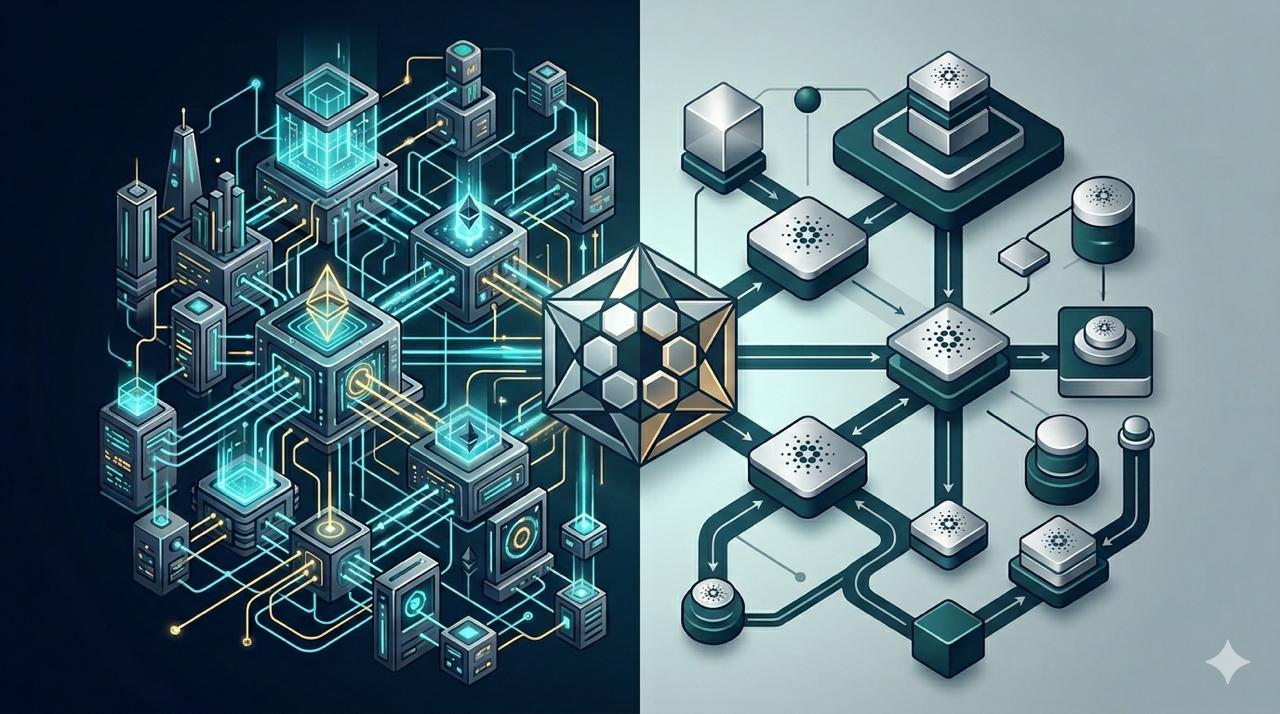
For the past few years, when the blockchain world talked about “composability,” it usually meant Ethereum-style synchronous calls: contracts behaving like public APIs, calling one another directly and composing complex behavior inside a single transaction. This Lego-like model fueled the rise of DeFi, and it also made execution-oriented agents such as those enabled by EIP-4337 increasingly powerful.
But once we shift the perspective from “serving human developers” to “serving AI agents,” the optimization target at the base layer changes fundamentally.
If AI becomes the primary user, then the system should not optimize first for “execution freedom.” It should optimize for predictability, verifiability, and explicit permission boundaries. If we follow that logic seriously, we arrive at a conclusion that may surprise many people: the base ledger of an AI-native blockchain should look more like Cardano than Ethereum.
1. Determinism Matters More Than Freedom
Ethereum’s strength lies in maximizing runtime freedom, but the trade-off is uncertainty during execution. You send a transaction, and until it is actually included, you may not know exactly which states it will touch or how much gas it will ultimately consume.
For humans, that is just a stylistic difference. For AI, it is highly inefficient. AI is strongest when it can plan first, validate constraints first, and then execute.
Cardano’s eUTXO model naturally fits that mindset. Transaction processing is deterministic. An AI system can locally predict the effects of a transaction with high precision, rather than throwing complexity into a black box that only reveals itself during execution. For workflows that must self-iterate, recover from failure, and retry intelligently, an architecture that can be reasoned about before execution is much friendlier than one that can only be understood during execution.
2. “Explicit Orchestration” vs. “Implicit Invocation”
Ethereum contracts are open to one another. A calls B, B calls C, and the control flow unfolds dynamically at runtime. This is extremely powerful for dense atomic operations, but it also makes risk boundaries blurry. At design time, you may think you are invoking one interface; at runtime, that action may trigger a long chain of nested calls and state transitions.
Cardano, by contrast, restricts direct contract-to-contract calls and forces developers to do more orchestration off-chain: choosing inputs, satisfying validation conditions, and constructing transactions explicitly.
Many people see this as a loss of expressiveness. But for AI agents, it can actually be an advantage. The complexity is surfaced explicitly. From the perspective of AI, that makes the system feel more like a solvable workflow problem than an opaque dynamic environment. AI is good at handling constraints. It is not afraid of strict rules; it is afraid of unclear boundaries.
3. From “Atomic Mega-Moves” to Recoverable Workflows
Ethereum optimizes for all-or-nothing atomicity. You stuff every action into one transaction, and it either succeeds all at once or rolls back all at once.
But the typical logic of an AI agent is usually long-lived:
- fetch state -> generate plan -> validate locally -> execute steps -> if failure occurs, re-orchestrate.
That pattern resembles a distributed workflow more than a single atomic on-chain action. In Cardano, eUTXO state is represented as discrete resources. When a transaction fails, it usually means the preconditions changed, and the AI only needs to choose new inputs and re-plan. This retryable and recoverable execution style fits the intuition of long-running AI systems much better than forcing all logic into a single atomic blast.
4. The Ledger as a Resource Scheduling System
If the future involves thousands or millions of agents collaborating, then the central problem becomes: how are resource dependencies declared, and which states can be processed in parallel?
Cardano expresses state as discrete resources (UTxOs), and application design is pushed from the beginning to avoid contention around a single global state point. That makes its base model look more like a resource scheduling and constraint-satisfaction system.
An AI-native blockchain should not ask, “Can I call everything freely?” It should ask, “Can I declare resources clearly, and can I handle conflicts explicitly?” Under that philosophy, the base ledger looks less like a purely imperative runtime and more like a declarative constraint system.
Final Convergence: A Hybrid Future
None of this means Cardano has already won.
Today’s Cardano still has a long way to go in agent permission models, standard interfaces for off-chain orchestration, and task-queue handling. Meanwhile, Ethereum’s ecosystem has accumulated extremely valuable experience in account abstraction and modular execution.
My own view is that the base layer of future AI-native chains will absorb Cardano-like deterministic resource models, while preserving Ethereum’s hard-earned flexibility at the account and middleware layers.
So the real question is not “which one replaces which.” The more important question is this: when we build infrastructure for machine societies, should the foundation be a loose execution environment, or a rigorous constraint system?
If projects like Aiken—where property-based testing is treated as a first-class citizen—are any indication, the answer is becoming clearer.
For the human side of this infrastructure, read My First Territory in the Digital World. For delegation mechanics and Pao Pool verification, use the Cardano staking guide.